

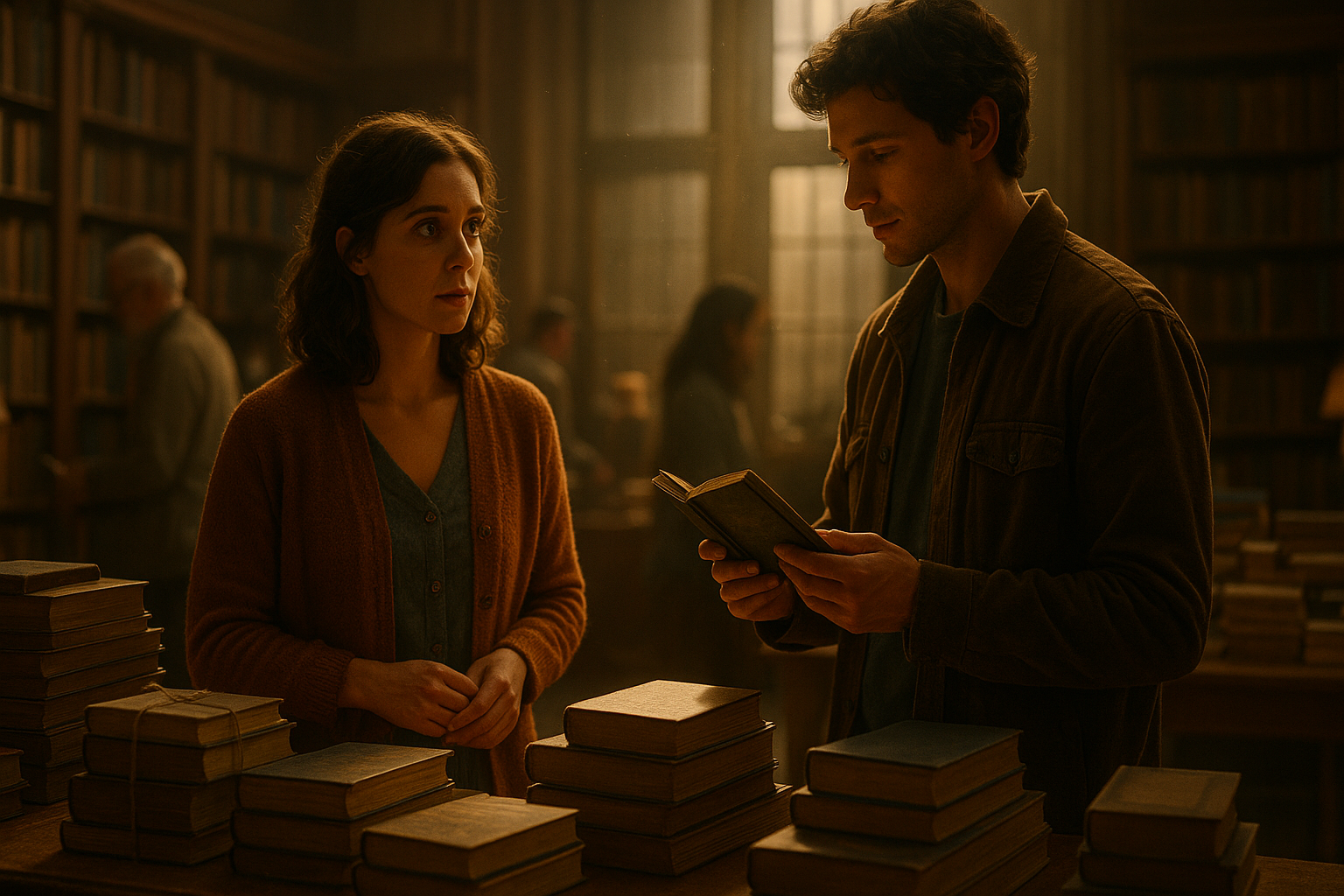
The first book appeared on a Tuesday evening, long after the library had closed, when the rain was coming down in gentle, undecided sheets and the town felt like it was exhaling in relief after a day of holding itself too tightly. The building—an old stone-and-brick structure whose windows bowed slightly as though tired from watching so many seasons—had already been locked for hours. No lights glowed inside except for the lonely desk lamp in the back corner, where June, the night librarian, often forgot she’d left it on.
June was walking home when she saw it.
She had just passed the front steps, umbrella angled sideways against the drifting wind, when she noticed something pale lying under the stone lion statue. At first she thought it was a flyer or a wet newspaper, but then the shape caught the glow from the streetlight—rectangular, unmistakably solid.
A book.
It was strange enough to be out in the rain. Stranger still, the cover looked impossibly dry. June blinked at it through the wavering curtain of water. She crouched down and lifted the book from the ground.
It was a hardcover. Deep blue cloth binding. No title on the spine.
But the moment she touched it, her breath caught.
She knew this book.
Or rather—she had known it, once, when she was twelve and believed that books could move the world like wind. She had borrowed it from the school library and never returned it, convinced she had lost it forever. She remembered the cover vividly: a child standing under a lamplit sky, holding a paper boat that glowed from within. A quiet, magical little story she had loved so fiercely and briefly that it became a part of her before she even realized she’d memorized half its lines.
But she had never seen this particular copy again. The school library no longer existed; the building had been converted into office space years ago. The book had gone out of print. She had searched for used versions every birthday, every holiday, every few years whenever the memory resurfaced like a small ghost—but it had vanished into the fog of the world, irretrievable.
And yet here it was. Dry. Waiting.
June stood in the rain with the book in her hands and felt the impossible weight of something returning to her. She looked up at the silent library windows, then down at the book again, heartbeat uneven. She pressed her thumb to the cover as if testing its reality.
There—faint, but real—she felt warmth.
Not like heat from a radiator or body temperature, but like something that had been recently held by a memory.
She slipped it into her bag and hurried home, water running off her umbrella like silver threads.
By the time she reached her apartment, another book was waiting on her doorstep.
This one small and soft-covered, with a cracked spine. A YA romance she had lent to her cousin Anna when they were fifteen. Anna had sworn she would give it back. She never did.
June’s hands shook as she picked it up.
“Okay,” she whispered to her empty hallway. “I don’t know what you are, but this is not a coincidence.”
She placed the books gently on her kitchen table. She stared at them. They stared back, silently patient.
Then her phone buzzed.
It was a text from Anna.
Did u ever find that book I borrowed? Been thinking abt it today weirdly. Sorry again I lost it.
June stared at the message, pulse wavering.
The books sat in a neat, accusing row. Or perhaps not accusing—perhaps simply returned.
Returned by what?
She didn’t sleep well.
The next morning June arrived at the library early. The storm had passed. The air outside smelled like wet pavement and softened earth. And on the library steps—
There were more books.
Dozens.
Stacked in quiet, reverent piles. Some tied with string. Some old and stained. Some crisp and new-looking.
All dry.
June approached them slowly. There was a postcard taped to the top of one stack. The handwriting was loops and curls that didn’t belong to any patron she recognized.
For the ones you lost, and the ones who lost you.
June felt the words settle into her like a stone dropped into deep water.
She touched one of the books in the nearest stack—a thick volume on astronomy. When she lifted it, a tiny slip of paper fluttered out.
Property of: DARREN WEST — GRADE 8
Her brother.
Her breath caught. Darren had died when she was seventeen. The book had vanished from his room during the blur that followed. She had spent years wishing she had something—anything—that he’d last touched. A bookmark, a scribble, a scrap of homework. And here—here was a book with his name in the childish handwriting she remembered vividly from when they shared chores and secrets in the same house.
June pressed the book to her sternum and closed her eyes. The air felt too thin.
The world was shifting. Quietly. Gently. As if some unseen hinge had turned in the night.
She dragged the stacks inside, heart rattling, mind racing. The library had never held so many ghosts at once.
And then the doors opened, and the town walked in.
The first patron was Mrs. Hanley, a retired art teacher who’d been coming to the library since before June was born. She entered with her usual cheerful wave—until she saw the display table where June had arranged the mystery books.
She froze.
“Where… where did you get these?” she asked.
June cleared her throat. “They were left outside this morning. I think—” She hesitated, unsure how to phrase the impossible. “I think they’re being returned.”
“Returned by who?” Mrs. Hanley whispered, approaching the table as if it were an altar.
“I don’t know,” June admitted. “But I think they’re meant for specific people.”
As if reaching through decades, Mrs. Hanley lifted a thin volume from the center of the table. Its cover was a pale watercolor wash of pinks and blues.
Her breath broke.
“Oh,” she whispered. “Oh, my heart. I thought it was gone forever.”
She opened the book with trembling fingers. Inside, scribbled in colored pencil, were notes from the class she’d taught her first year—tiny corrections, little doodles from students who had adored her.
June watched her press the book to her cheek.
“I lost this in the move after my husband died,” Mrs. Hanley murmured. “I cried over it for weeks.”
June felt her throat tighten. “It’s yours again.”
Mrs. Hanley looked at her then, eyes shining. “Dear girl,” she whispered, “this library is a holy place.”
Word spread faster than June expected.
By noon, the library was full.
People moved through the aisles with reverence, searching the tables, the stacks, the chairs where new piles appeared every few minutes as if some invisible delivery person passed through the air unnoticed.
A teenage boy found the blank journal he’d filled during a summer abroad, lost at an airport he couldn’t even remember the name of.
A woman found the cookbook her mother had used every winter before she passed, pages still dusted with old flour.
A man found a dog-eared comic book signed by his best friend the year they stopped speaking.
Some cried. Some laughed. Some stared at their books as if they were seeing old lovers returned after long silence.
One child—maybe seven—ran to her father waving a copy of a picture book.
“Daddy! Daddy! Look! It’s the one with the singing frogs! Grandma read this to me when I was little!”
Her father froze. Slowly, he knelt and took the book.
“I thought… I thought we left this behind when we moved,” he whispered. His eyes filled before he could stop them.
June watched them, heart swelling painfully.
The library had become a living, breathing memory.
Marvels & Small Miracles, she thought. She had always believed in them quietly, the way you believed in fireflies or long-lost coins in the couch—small, rare, but possible.
But this was different.
This was not small.
The strangest thing was that no one tried to claim a book that wasn’t theirs.
Each person seemed drawn to something specifically meant for them. They would scan the piles anxiously until their breath caught on a spine or a cover or a crease that sparked an ache of recognition.
It was as though the books themselves whispered: Here. I remember you.
June moved through the crowd like a caretaker of something sacred. Her hands felt warm, her pulse steady despite the whirlwind of emotion around her.
She didn’t know who was orchestrating this—what force was returning these lost pieces of people’s lives—but she understood that it wasn’t malicious. It wasn’t chaotic.
It was merciful.
When the sun began to lower and spilled golden light across the dusty library windows, the last patron of the evening hesitated in the doorway.
It was Leo.
June’s breath caught. She hadn’t expected him.
He stepped inside quietly. His shoulders hunched slightly, as if he wasn’t sure he was allowed to take up space here. His curly hair was damp from the rain. His eyes—warm, amber-colored, familiar—swept over the room.
“Hi,” he murmured when he reached June’s desk.
“Hi,” she said, too quickly.
They hadn’t spoken in months.
Not since the breakup—quiet, mutual, gentle but painful in the corners. They’d said it was timing. They’d said they needed space. They’d said they would stay friends.
They hadn’t.
“I heard something strange was happening,” Leo said softly. “I wasn’t sure I should come.”
“You should,” June said, voice steadier than she felt.
Leo looked around slowly, at the shelves bursting with returned memories, the tables covered in little reunions.
“So… what is all this?”
“I don’t know,” June said honestly. “But it’s giving people back what they lost.”
Leo absorbed that.
Then he asked, too lightly, “Is there something for me?”
June swallowed.
“I don’t know,” she said again. “Maybe. You can look.”
Leo began walking the aisles.
June watched him with a painful, yearning ache. She hadn’t expected seeing him again to feel like this—as if the library’s magic had loosened something in her chest she’d kept locked up long before the breakup.
He moved slowly, scanning titles, lifting covers, pausing when a memory seemed to tug at him.
When he reached the far corner, he stopped.
June held her breath.
He picked up a small, square book. One June recognized instantly.
Not because it was hers—but because she had bought it for him on their first anniversary. A photography book of nighttime cityscapes from around the world. He had lost it during a move years before they’d even met.
He ran his thumb over the cover, stunned.
“I can’t believe this,” he whispered.
June approached him softly.
“That book was important to you,” she said.
“It was,” he murmured. “It made me want to learn long-exposure photography.” He exhaled shakily. “I thought it was gone forever.”
June nodded. “A lot of people today thought that.”
Leo turned the book over in his hands. His expression had changed—something softening, something opening.
“June,” he said quietly. “Can I ask you something?”
She met his gaze. “Of course.”
“Do you ever think some things get lost because we’re not ready for them yet?” he asked. “And maybe… when they come back, it’s because we’ve finally become the kind of people who can hold them again?”
June felt the words settle into her like the quietest kind of truth.
“I think…” She swallowed. “Sometimes things return so we can choose them a second time. Or let them go properly. Or… figure out what they meant.”
Leo stepped a fraction closer.
“Then what do you think this means?” he asked, lifting the book slightly.
June looked at him—not the past him, not the hurt or the silence or the ending, but the him standing here now, in a library full of second chances.
“I think,” she said slowly, “it means you’re ready to remember the parts of yourself you thought were gone.”
“And us?” Leo asked so quietly it almost wasn’t sound.
June’s heart gave a single, painful thud.
“I think that’s a story we don’t have to rush,” she said gently. “But maybe… maybe we can return to it someday.”
Leo’s smile was small but real. “I’d like that.”
Something eased in June’s chest.
Around them, the library glowed in the fading light, dust motes floating like soft constellations, books breathing quietly in their places, settled after their long journeys home.
In the warm hush of the evening, the last small miracle of the day unfolded softly between them—not a returned book, but a returned possibility.
A story not lost, but simply waiting.
And in the quiet, June understood:
Some marvels arrive loudly.
But the ones that change us forever—
the ones we never forget—
arrive like this:
Soft as rain.
Sure as memory.
And right on time.